
For solo attorneys, billing is more than an administrative task. It directly affects revenue, cash flow, and the overall stability of the practice.
Unlike larger firms, solo attorneys usually manage both legal work and billing responsibilities themselves. That makes efficiency especially important.
When billing workflows become inconsistent, problems build quickly. Time gets missed, invoices are delayed, and administrative work starts consuming more of the day.
Strong billing habits help solo attorneys reduce friction, improve cash flow, and recover billable time that might otherwise be lost.
Why Billing Efficiency Matters for Solo Attorneys
Solo attorneys work without the operational support structure larger firms often have.
That means billing delays affect the attorney directly:
- Revenue arrives later
- Administrative work increases
- Time tracking becomes harder to maintain
- Cash flow becomes less predictable
Even small inefficiencies can create noticeable financial impact over time.
For solo practices, billing consistency is often just as important as client acquisition.
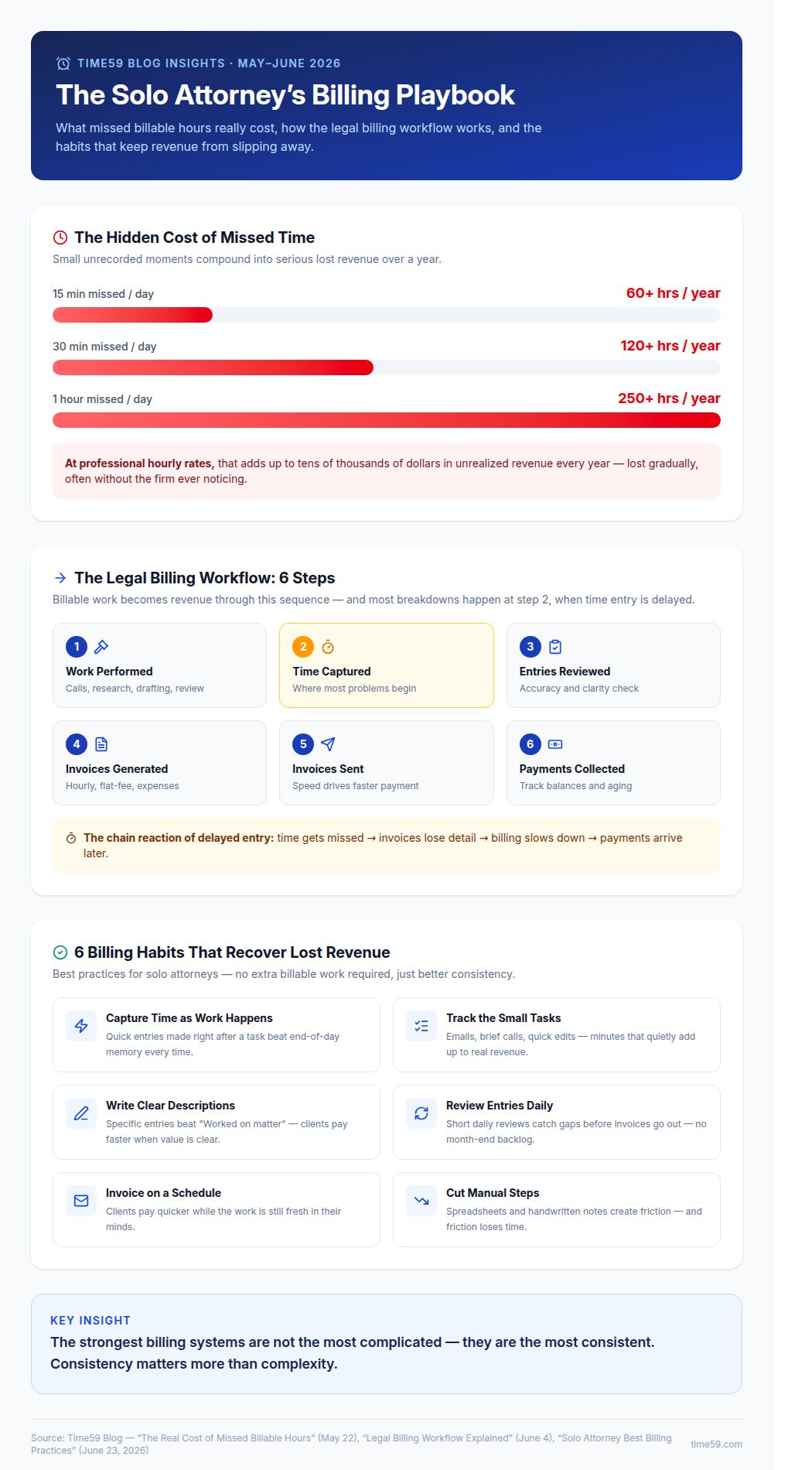
Capture Time As Work Happens
One of the most important billing habits is entering time as close to the work as possible.
Waiting until the end of the day creates several problems:
- Small tasks are forgotten
- Descriptions lose detail
- Billing becomes less accurate
- Time reconstruction takes longer
Capturing work throughout the day improves both accuracy and consistency.
Even quick entries made immediately after tasks are usually more reliable than relying on memory later.
Track Small Tasks Consistently
Solo attorneys often overlook smaller billable activities because they feel insignificant in the moment.
This may include:
- Reviewing emails
- Brief client calls
- Short edits
- Quick legal research
- Internal file review
- Follow-up communication
Individually, these tasks may only take a few minutes. Collectively, they represent meaningful billable time.
Consistently recording small tasks helps prevent revenue from quietly disappearing throughout the day.
Use Clear Billing Descriptions
Billing descriptions affect both professionalism and payment speed.
Vague invoice entries can create confusion or client questions. Clearer descriptions improve transparency and help clients understand the value of the work performed.
Instead of writing:
"Worked on matter"
More specific entries explain the actual task completed.
Detailed descriptions also make invoices easier to review later if questions arise.
Reduce Manual Administrative Work
Many solo attorneys still rely on:
- Spreadsheets
- Handwritten notes
- Separate invoicing systems
- End-of-day reconstruction
These workflows create additional administrative overhead and increase the likelihood of missed time.
The more manual the process becomes, the harder it is to maintain consistency during busy periods.
Reducing unnecessary steps helps make billing more sustainable long term.
Review Time Entries Regularly
Regular review helps catch missing or incomplete entries before invoices are prepared.
This improves:
- Billing accuracy
- Invoice clarity
- Revenue capture
- Workflow consistency
Daily or near-daily review is usually more effective than trying to fix billing gaps at the end of the week or month.
Short review sessions are easier to maintain and create less administrative backlog.

Send Invoices Consistently
Consistent invoicing improves payment timing.
When invoices are delayed:
- Clients take longer to pay
- Outstanding balances grow
- Cash flow becomes less predictable
Sending invoices on a regular schedule creates more stable billing cycles and reduces administrative stress.
Clients are also more likely to pay quickly when work is still recent and clearly remembered.
Avoid Overcomplicating the Billing Process
Some solo attorneys attempt to build highly detailed billing systems with too many steps, categories, or review layers.
In practice, overly complex workflows often become harder to maintain.
Efficient billing systems prioritize:
- Simplicity
- Consistency
- Speed
- Ease of use
The goal is not creating the most advanced workflow possible. The goal is creating one that can be maintained consistently during real workdays.
Why Billing Delays Hurt More Than Revenue
Delayed billing affects more than immediate cash flow.
It also creates:
- Mental backlog
- Administrative stress
- Larger reconstruction sessions
- Lower billing accuracy
- More frustration around invoicing
Over time, billing delays increase operational friction across the entire practice.
Many solo attorneys find that simplifying billing improves both productivity and overall workflow management.
What Efficient Solo Attorney Billing Workflows Have in Common
Efficient workflows are designed to reduce friction between work performed and revenue collected.
They make it easier to:
- Capture time quickly
- Review entries consistently
- Generate invoices faster
- Reduce administrative workload
- Maintain predictable billing cycles
The easier billing becomes to maintain, the more sustainable it becomes over time.
How Time59 Fits Into Solo Attorney Billing
Time59 is designed to simplify billing workflows for solo attorneys and small firms.
Instead of relying on delayed reconstruction or fragmented systems, attorneys can capture work as it happens and move efficiently from time entry to invoicing.
This helps reduce:
- Missed billable hours
- Administrative overhead
- Billing delays
- Workflow inconsistency
For solo practices, simpler billing workflows often improve both efficiency and revenue visibility.
Final Perspective
For solo attorneys, billing efficiency directly affects the health of the practice.
Missed time, delayed invoices, and manual workflows create unnecessary friction that compounds over time.
The strongest billing systems are usually not the most complicated. They are the most consistent.
By simplifying time tracking, reviewing entries regularly, and reducing manual administrative work, solo attorneys can improve billing accuracy, accelerate payments, and create a more sustainable workflow overall.
FAQ
What are the best billing practices for solo attorneys?
The best billing practices include entering time throughout the day, tracking small tasks consistently, reviewing entries regularly, and sending invoices on a predictable schedule.
Why do solo attorneys lose billable time?
Solo attorneys often lose billable time because of delayed time entry, manual tracking systems, forgotten small tasks, and inconsistent billing workflows.
How can solo attorneys improve billing efficiency?
Solo attorneys can improve billing efficiency by simplifying time tracking, reducing manual administrative work, using consistent invoicing schedules, and adopting systems that make billing easier to maintain daily.
The Billing Playbook at a Glance